
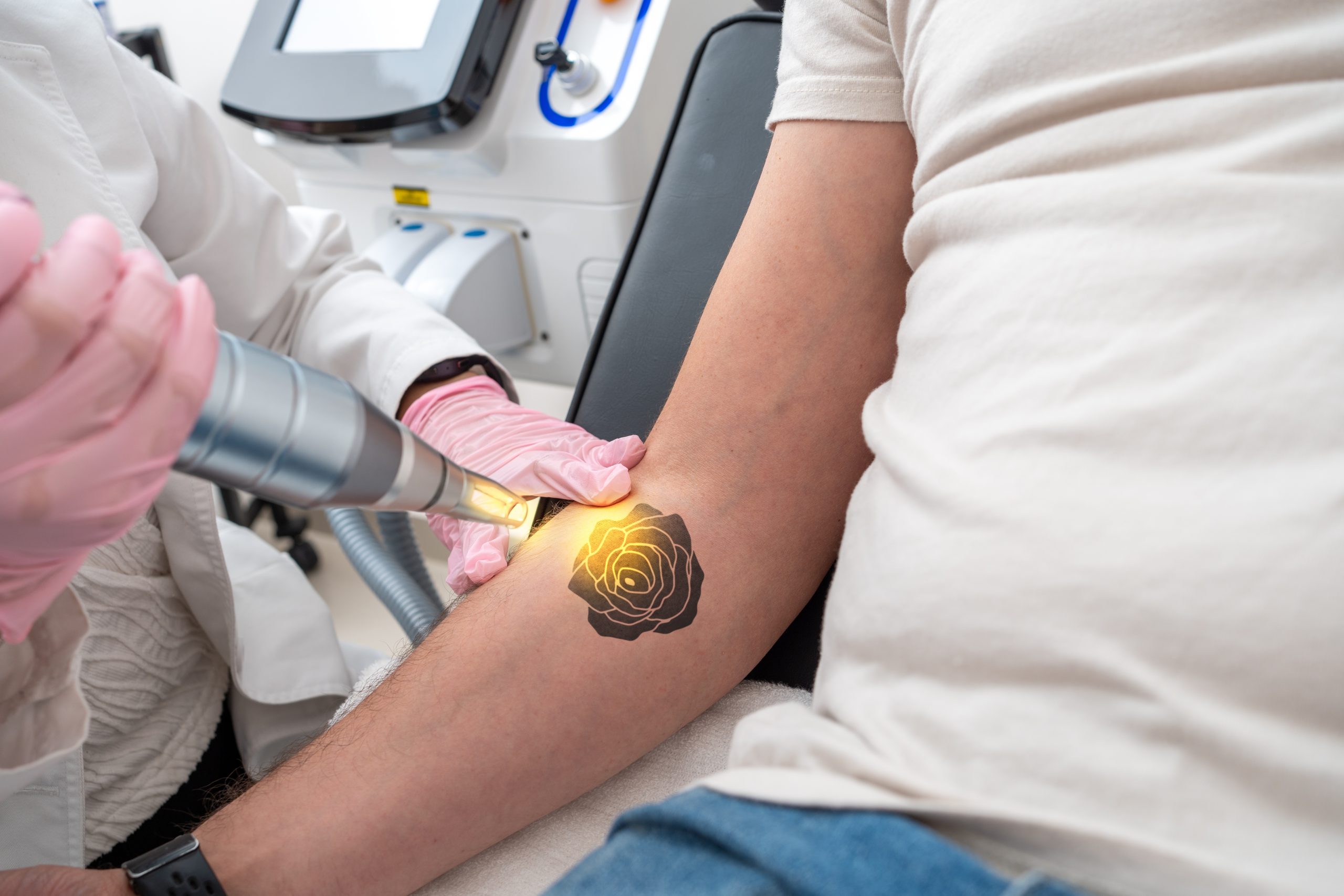
Laser tattoo removal is a medical procedure, not a spa service – and having a physician perform it matters because a doctor can evaluate your skin type, identify medical conditions that change how your skin heals, adjust laser settings safely, and manage any reaction that comes up during or after treatment.
At Bod Medical in Central Jersey, every laser treatment is performed under the care of Dr. Bradley Bodner. That physician-level oversight is the difference between a treatment that fades ink cleanly and one that leaves scarring or lasting pigment changes.
Below, we break down what laser tattoo removal is and why having a doctor perform your laser tattoo removal matters.
Tattoo ink is made of pigment particles that are too large for your immune system to remove – that’s why tattoos are permanent. A tattoo removal laser delivers extremely short pulses of light calibrated to a wavelength absorbed by the ink, not the surrounding skin. The rapid energy absorption heats the particles and scatters them, much like breaking a large rock into tiny pebbles.
Once the fragments are small enough, white blood cells called macrophages engulf them, and the lymphatic system gradually carries them away – the same natural process your body uses to clear infection and cellular debris. This is why results appear over weeks, not minutes, and why sessions must be spaced apart.
The number of sessions depends on ink depth, ink color, the age of the tattoo, whether it was applied by a professional or an amateur, and how efficiently your body clears the fragments. There is no universal number, which is exactly why an individual assessment matters.
It is crucial to understand that the laser doesn’t just interact with ink. It interacts with your skin, your immune system, and any underlying health conditions you have.
A laser powerful enough to shatter tattoo pigment is powerful enough to burn skin if used incorrectly. Energy levels, pulse duration, spot size, and cooling all have to be dialed in for the specific patient in the chair.
Dr. Bodner brings training in skin anatomy, physiology, wound healing, infection, and pharmacology to those decisions. A non-medical technician cannot legally or safely do that.
Not all skin responds to laser energy the same way. Deeper skin tones carry more melanin, and melanin absorbs laser light just like tattoo ink does. Without careful settings and a conservative approach, that can lead to hypopigmentation (light patches) or hyperpigmentation (dark patches) that outlast the tattoo itself.
A physician evaluation looks at:
Skin type and natural pigment level – assessed using a scale like the Fitzpatrick scale
Ink colors present – black and dark blue respond fastest because black absorbs all laser wavelengths; greens, light blues, and yellows are more stubborn
Tattoo age and depth – older, faded tattoos often clear more readily than newer ones
Scarring from the original tattoo – pre-existing scar tissue changes the plan
Location on the body – areas with better circulation, like the chest or upper back, clear faster than ankles and fingers
Health history and medications – autoimmune conditions, diabetes, keloid tendency, photosensitizing medications, and recent sun exposure all matter
There is no single protocol that fits every tattoo. Dr. Bodner determines the optimal laser settings, the number of sessions you’ll likely need, and the ideal interval between treatments – setting realistic expectations for what “finished” will look like for your specific tattoo.
Patients undergoing or recovering from cancer treatment – or with a history of skin cancer – need extra caution. Chemotherapy and radiation can affect immune function, skin integrity, and wound healing, and because removal depends on your immune system to clear pigment, compromised function can slow or limit results.
Radiation-treated skin is also more fragile and may react differently to laser energy. Some patients seek removal of radiation therapy tattoo markers after treatment ends – a reasonable goal, but one requiring timing and coordination with oncology care. This is exactly the kind of situation where physician evaluation is not optional.
Used properly, no. It’s the technique. Excess energy, wrong wavelength, inadequate cooling, or sessions spaced too closely are what cause burns and scarring – and those are all operator decisions.
Do:
Keep the tattoo out of the sun for at least four weeks before treatment
Disclose all medications and supplements, including antibiotics and acne medications
Shave the treatment area if there’s hair, unless told otherwise
Arrive with clean, product-free skin – no lotions, creams, or fragrances
Stay well hydrated – your lymphatic system does the clearing work
Don’t:
Use self-tanner, spray tans, or tanning beds before a session
Take blood thinners, high-dose aspirin, or ibuprofen without checking first
Book a session over sunburned or irritated skin
Schedule treatment right before a beach vacation or major event
Do:
Keep the area clean, dry, and covered as directed for the first 24–48 hours
Apply a thin layer of the recommended antibiotic ointment to keep the skin moist
Use cool compresses for swelling and discomfort
Protect the area with broad-spectrum SPF 30+ sunscreen once healed
Let blisters resolve on their own
Don’t:
Pick, scratch, or peel scabs – this is the leading cause of scarring
Soak in pools, hot tubs, or baths until fully healed
Exercise heavily in the first 24 to 48 hours
Apply makeup or fragranced lotions over the treated skin
Expose the treated area to direct sunlight
Expect dramatic change after one session – fading is cumulative
Understanding the importance of professional oversight comes down to one idea: the laser is only as safe and effective as the judgment guiding it. At Bod Medical, serving Central Jersey, laser tattoo removal is delivered under the care of Dr. Bodner, who is highly experienced in laser procedures and offers deep anatomical expertise.
About the Author
Dr. Bradley Bodner
August 6, 2026