
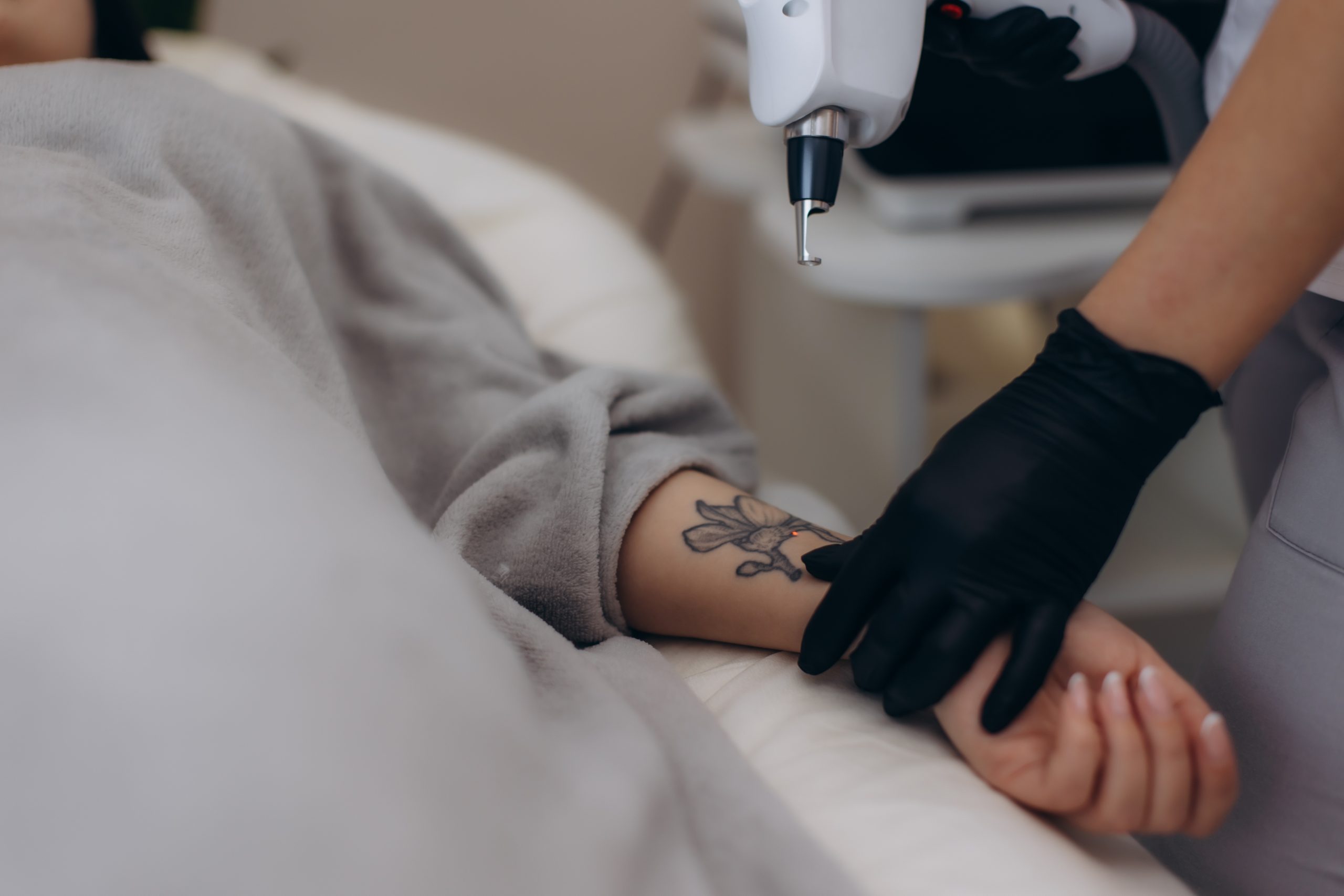
Most professional tattoos require between 6 and 12 laser removal sessions for significant clearing, but the exact number depends on factors like your tattoo’s size, colors, age, skin type, and your body’s response. At Bod Medical in Marlboro Township, NJ, a personalized laser tattoo removal plan is created during your initial consultation to give you a precise estimate.
Every tattoo tells a story, but sometimes you’re ready to start a new chapter. Below, we break down what shapes your session count and what to expect along the way.
Laser tattoo removal works in partnership with your body’s natural immune system – it’s not an eraser that wipes ink away in one pass. The specialized laser delivers concentrated pulses of light energy that are selectively absorbed by the tattoo ink particles, leaving surrounding skin unharmed.
When the ink absorbs this energy, it shatters into millions of microscopic fragments. Your immune system then takes over: white blood cells called macrophages engulf these tiny particles and carry them away for natural elimination.
This is why sessions are spaced several weeks apart – typically six to eight. This gap gives your skin time to heal and your immune system time to clear the shattered ink. Rushing the process is ineffective and can increase skin irritation. Each session chips away at the tattoo, causing it to fade gradually.
While 6 to 12 sessions is a common benchmark for professionally applied tattoos, it’s just an average. Some people see results in as few as 4 or 5 sessions, while complex or dense tattoos might require 15 or more.
Amateur or “stick-and-poke” tattoos often require fewer sessions. The ink is typically not placed as deeply or evenly as with a professional tattoo gun, so the laser can reach and break it up more easily.
During your consultation at our office, Dr. Bradley Bodner will carefully evaluate your tattoo and discuss your goals to provide a clearer picture of your specific treatment course.
Several critical factors influence the speed and effectiveness of removal.
A small wrist tattoo requires less time per session than a full back piece – but location also affects how quickly a tattoo fades. Tattoos in areas with strong blood flow clear faster, because circulation helps immune cells reach and carry away the shattered ink.
Fade faster: chest, torso, neck, and upper arms (better circulation)
Fade slower: hands, feet, ankles, and lower legs (weaker circulation)
Different ink pigments absorb different wavelengths of light, which affects your timeline:
Dark Inks (Black, Dark Blue): Easiest to remove – black absorbs all laser wavelengths, and dark blues respond well.
Bright Colors (Red, Orange, Brown): Respond well to specific laser wavelengths.
Challenging Colors (Green, Light Blue, Light Green, Yellow, Purple): The most stubborn; these need very specific wavelengths and often more sessions.
The density and depth of the ink also matter. Heavy shading and deep, saturated lines take longer to remove than fine lines and lighter applications.
Older tattoos are often easier to remove than fresh ones. Over the years, your immune system has already faded some of the ink, giving the laser a head start. A tattoo from a decade ago may clear in fewer sessions than one from last year. Fresh tattoos also need to be fully healed before treatment can begin.
Your skin tone, often categorized by the Fitzpatrick scale, affects the laser settings we use. The laser targets ink pigment, but melanin – your skin’s natural pigment – can also absorb it.
Lighter skin tones offer greater contrast, allowing the laser to target ink more directly. This careful approach keeps your skin healthy but may mean a few extra sessions.
Since your immune system clears the ink, your overall health is key. Factors that support a robust response include:
Staying Hydrated: Water helps your lymphatic system function optimally.
Healthy Diet & Exercise: Good circulation and wellness support removal.
Not Smoking: Smoking constricts blood vessels and impairs circulation, which can significantly slow fading and increase the number of sessions needed.
You won’t walk out with clear skin – laser tattoo removal is a gradual journey of fading. Many patients notice fading after their first session, with most seeing clear changes by the second or third session. Right after treatment, the tattoo may look “frosted” or white, or slightly red and raised – a temporary effect that subsides quickly.
The most dramatic fading often occurs by the halfway point of your plan, once your body has processed a few cycles of broken-down ink. Keeping a simple photo log at home can help you track gradual progress that’s hard to notice day to day.
Yes – your estimate can shift as treatment progresses. If ink fades faster than expected, the total may be reduced. If it’s stubborn or certain colors resist the laser, additional sessions may be recommended. This is completely normal.
There are also things you can do to support the outcome:
Protect the treated area from the sun. Keep it covered or use sunscreen, as sun exposure slows healing.
Stay hydrated and healthy. Good hydration and a strong immune system help clear ink faster.
Avoid smoking. Cutting back improves circulation and results.
Follow all aftercare instructions. Proper care keeps skin healthy between visits.
Space sessions appropriately. Enough healing time between visits actually improves results.
Dr. Bodner will monitor how your tattoo responds and adjust your plan accordingly.
Your experience at our Central Jersey clinic is designed to be straightforward and comfortable. Sessions are quick – a small tattoo may take just a few minutes, while a larger one could take 20–30 minutes. Here’s what a typical visit looks like:
Preparation. The area is cleaned, and you and your provider wear protective eyewear since the laser light is very intense and poses a risk to the eyes.
Treatment. Dr. Bodner uses a handheld device to deliver quick pulses of laser energy. Most patients describe it as a rubber band snapping against the skin, and comfort options can be discussed beforehand.
Immediate reaction. It’s normal for the area to look red, slightly swollen, or lightly raised right after treatment; this settles over the following days.
Aftercare. A soothing ointment and bandage are applied, and you’ll get clear instructions on keeping the area clean and protected from the sun.
You’ll return every 6 to 8 weeks until your tattoo reaches the result you’re looking for.
So, how many laser tattoo removal sessions will you need? It truly depends on a unique combination of factors – the tattoo’s size, age, colors, and location, plus your skin type and overall health. While an average of 6 to 12 sessions spaced 6 to 8 weeks apart is a helpful starting point, the only way to get a reliable estimate is an in-person evaluation.
At Bod Medical in Marlboro Township, Dr. Bodner will assess your tattoo and build a plan suited to you – then adjust it as your skin responds. With a little patience and good aftercare, most patients are pleased to see their tattoos fade session by session.

About the Author
Dr. Bradley Bodner
July 6, 2026