
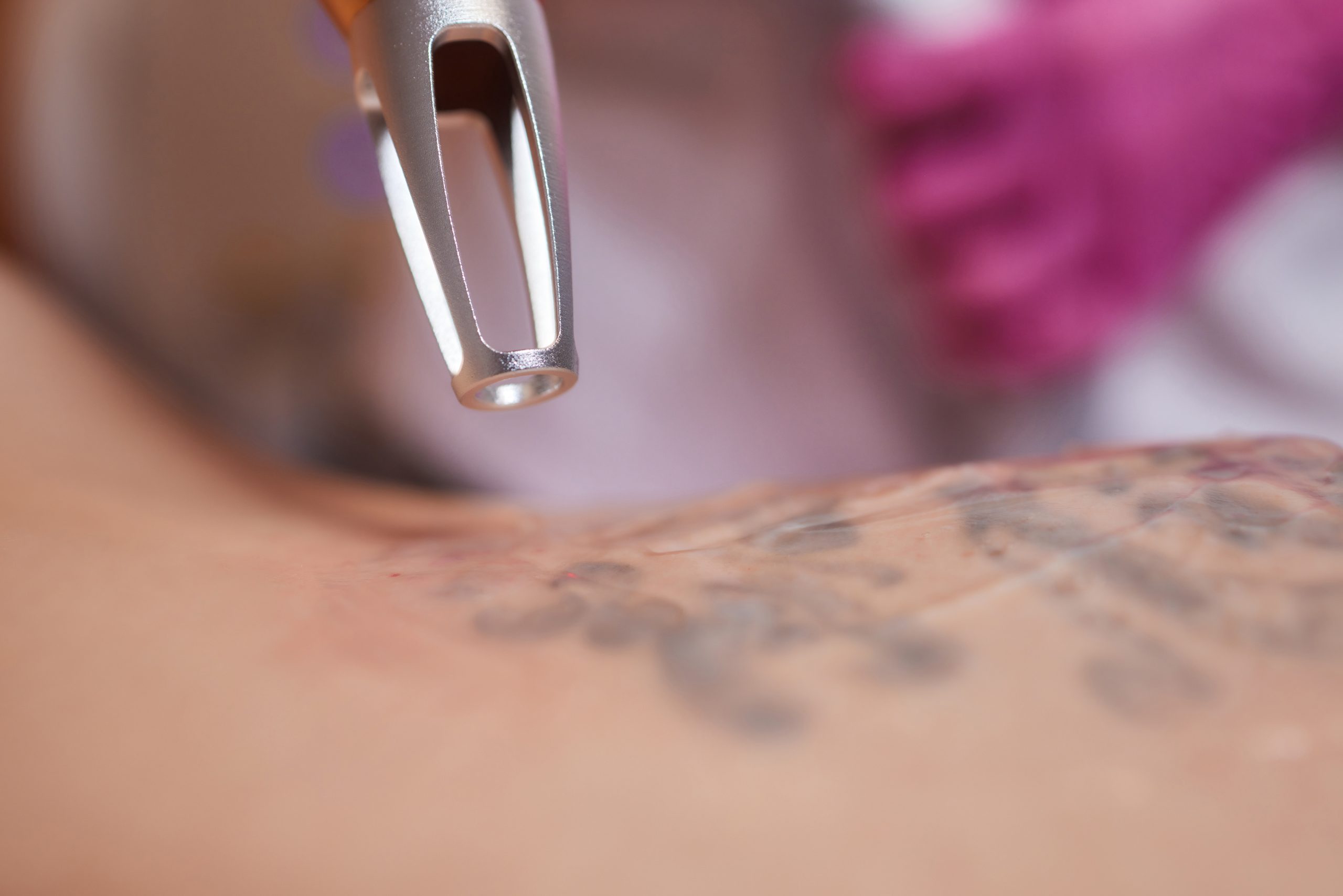
When considering laser tattoo removal, picosecond lasers offer faster ink clearance and typically require fewer treatment sessions compared to nanosecond lasers, though both technologies effectively remove tattoos when used by experienced providers.
At Bod Medical in Marlboro Township, our team utilizes both picosecond technology (PicoWay and PicoSure) and nanosecond technology (Medlite) as part of our Triple Laser lineup, allowing customized treatment based on each tattoo’s unique characteristics.
Laser tattoo removal works by delivering concentrated light energy to break apart tattoo ink particles embedded in the skin. The body’s immune system then naturally removes these fragmented particles over time. The main difference between laser types lies in how quickly they deliver this energy – measured in either nanoseconds (billionths of a second) or picoseconds (trillionths of a second).
Nanosecond lasers, like the Medlite Q-switched system used at Bod Medical, have been the gold standard for laser tattoo removal since the 1990s. A nanosecond is one billionth of a second.
These lasers work through photothermal action, using heat to break down large ink particles in your tattoo. They are particularly effective on:
Older tattoos
Black and dark blue inks
Dense, dark tattoos
Picosecond lasers represent a significant advancement in removal technology, delivering energy pulses 1,000 times faster than nanosecond lasers.
At Bod Medical, the PicoWay and PicoSure systems create a powerful photoacoustic effect that shatters ink particles through intense pressure waves. This results in:
Dust-like fragments much smaller than those produced by nanosecond lasers
Less heat buildup in the surrounding tissue
More comfortable treatments and faster healing times
Understanding the distinction between these two technologies helps clarify why a multi-laser approach is so effective. This is less about a winner and more about using the right tool for the job.
Think of a nanosecond laser as using a hammer to break a large rock into smaller pebbles. It gets the job done, but the pieces are still relatively large.
A picosecond laser is like a high-powered jackhammer that pulverizes that same rock into fine dust. The ultra-short pulse delivers immense pressure, shattering the ink with minimal heat transfer to the surrounding skin.
Because picosecond lasers shatter ink into much finer particles, the body can clear them more efficiently. This often leads to faster fading and more complete removal, especially for:
Stubborn, brightly colored inks, which were once considered difficult to remove
Previously treated tattoos
Blues and greens that resist traditional treatment
While every tattoo is unique, picosecond technology often reduces the number of treatment sessions by 20-40% compared to using only nanosecond lasers. The smaller ink particles are simply easier and faster for your body to process between appointments.
At Bod Medical, combining picosecond lasers with sound wave therapy can further enhance ink clearance between sessions.
This is where having access to multiple lasers becomes crucial. No single laser wavelength is effective on every ink color:
Nanosecond Lasers (Medlite):
Highly effective for black, dark blue, and some red inks
Excel at dense, dark tattoos
Picosecond Lasers:
PicoSure (755nm wavelength): Targets blues and greens effectively
PicoWay (1064nm, 532nm, 785nm wavelengths): Addresses virtually all tattoo colors
Excel at stubborn blues, greens, purples, reds, oranges, and yellows
Because picosecond lasers deliver energy so quickly, they generate less heat. Studies demonstrate particular advantages for removing blue and green inks, which traditionally resist nanosecond treatment.
However, experienced providers know that nanosecond lasers still have an important role, especially in initial sessions on dense, dark tattoos.
Dr. Bradley Bodner‘s 20+ years of experience and thousands of treatments performed mean optimized protocols regardless of laser type.
The question isn’t which laser is better, but which provider has the right combination of tools and expertise to treat your specific tattoo.
Dr. Bodner leverages his extensive experience to assess every tattoo individually. He may:
Start with a nanosecond laser to break down dense black outlines
Switch to picosecond lasers in later sessions for the remaining particles and colored inks
Use different lasers during the same treatment session
Alternate between technologies across sessions
This triple laser advantage – combining PicoWay, PicoSure, and Medlite technologies – sets Bod Medical apart from clinics with only a single device.
Ultimately, effective laser tattoo removal depends on more than just one machine. It requires a strategic, customized plan delivered by an experienced physician.
By combining the strengths of both nanosecond and picosecond lasers, our team can effectively target all ink colors and layers, offering a more complete and efficient removal process. Our location in Marlboro Township, NJ, serves the area with extended hours Monday through Saturday, making advanced treatments accessible for busy schedules.

About the Author
Dr. Bradley Bodner
April 27, 2026